


Welcome back to the Sunday Mass notes. This week, we open with a reading from the Prophet Ezekiel, where we learn about the seriousness of sin. Then we move to the second reading, continuing the study in the Book of Philippians. Finally, we conclude with the Gospel lesson from Saint Matthew.
Introduction to the First Reading:
The first reading is from the Prophet Ezekiel. The context is the Lord’s teaching on the seriousness of sin. “The soul who sins shall die” (v. 4d), the text says in the opening section of this chapter. Specifically, God taught on the seriousness of idolatry (v. 6), covetousness (v. 6), robbing the poor (v. 7), depriving the hungry of food and the poor of adequate clothing (v. 7), and charging interest on loans to a fellow Jew (v. 8). Obedience to God’s Laws flows from an obedient heart, one that has been changed through embracing the mystery of God’s love. Saint Paul said, “[F]or all have sinned and fall short of the glory of God” (Romans 3:23). And “For the wages of sin is death, but the free gift of God is eternal life in Christ Jesus our Lord” (Romans 6:23). God’s gift is eternal life, but it comes only through faith in Him. In the Old Testament, this meant trusting what they knew about God and looking forward to their Messiah Jesus’ future conquering of sin forever. In a sense, God had already provided salvation because Jesus is called the Lamb slain from before the foundation of the world, even though that event was yet to come (Revelation 13:8). Similarly, the Kingdom of Heaven is an already-not-yet proposition. Today, we receive eternal life by trusting what we know about God and looking back to what Jesus did for us on the cross.
A summary of this section is given in the verses that immediately precede the reading:
“Do I have any pleasure in the death of the wicked,” declares the Lord GOD, “rather than that he should turn from his ways and live? 24 But when a righteous man turns away from his righteousness, commits iniquity and does according to all the abominations that a wicked man does, will he live? All his righteous deeds which he has done will not be remembered for his treachery which he has committed and his sin which he has committed; for them he will die.” (Ezekiel 18:23-24)
With this context in mind, let’s proceed with the reading.
First Reading:
25 “Yet you say, ‘The way of the Lord is not right.’ Hear now, O house of Israel! Is My way not right? Is it not your ways that are not right? 26 When a righteous man turns away from his righteousness, commits iniquity and dies because of it, for his iniquity which he has committed he will die. 27 Again, when a wicked man turns away from his wickedness which he has committed and practices justice and righteousness, he will save his life. 28 Because he considered and turned away from all his transgressions which he had committed, he shall surely live; he shall not die.” (Ezekiel 18:25-28)
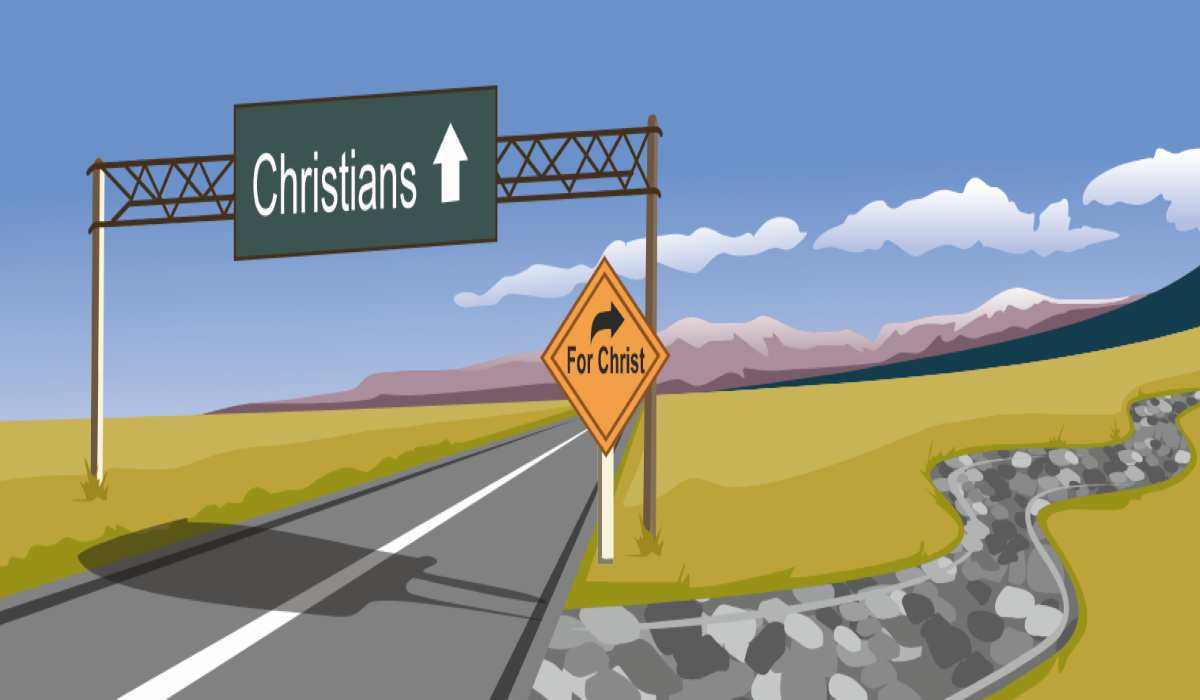
The reading is a study in contrasts: first, a wicked man who repented of his sin; second, one who continued in his sin to the point of death. We see in verse 26 that habitual sin can have serious consequences, even to the point of death. Let’s look more closely at the difference between someone whose heart has been renewed by God and someone who remains spiritually dead. Scripture clearly reveals two distinct classes of people, two different roads, with only one leading to heaven. Jesus called them the narrow road and the broad road (Matthew 7:13-14, below). The first class is those whose sins are forgiven and who are spiritually alive, born from above (John 3:3). Ezekiel said something about this earlier in this chapter: “All his transgressions which he has committed will not be remembered against him; because of his righteousness which he has practiced, he will live” (Ezekiel 18:22). The second class is those whose souls are spiritually dead and whose sins will be held against them for an eternity after they die. This is a crucial point, especially since most people in the world are unknowingly on the broad road. Jesus said, “Enter through the narrow gate; for the gate is wide and the way is broad that leads to destruction, and there are many who enter through it. For the gate is small and the way is narrow that leads to life, and there are few who find it” (Matthew 7:13-14). If a person never truly experiences and trusts in God’s saving grace through faith in Jesus, then their soul remains spiritually dead during their life on earth. When they die physically, their already dead soul enters the abode of the dead, and at some future point they will experience a second death. This fearsome event is enough to scare anyone, and the Book of Revelation describes it. “But for the cowardly and unbelieving and abominable and murderers and immoral persons and sorcerers and idolaters and all liars, their part will be in the lake that burns with fire and brimstone, which is the second death” (Revelation 21:8). “And if anyone’s name was not found written in the book of life, he was thrown into the lake of fire (Revelation 20:15).
Let’s go back to the reading. In verse 27, God said, “When a wicked man turns away from his wickedness which he has committed and practices justice and righteousness, he will save his life.” Is God saying that a person earns their way to heaven by their good works? No; Scripture is clear that good works flow from a heart regenerated by God. Yes, nonbelievers can do good works, but their motivation differs from that of a child of the kingdom. Even though they are spiritually dead, they are still human beings created in the image of God. Whatever they do flows from their existence as an image-bearer of God, but their deeds do not result in eternal life. The Scripture shows that works pleasing to God flow from a heart submitted to God through faith in Jesus Christ. Jesus said this plainly in John 6:29. When people asked what they should do to fulfill the works that God requires, Jesus answered, “The work of God is this: To believe in the one He has sent.”
Ezekiel’s message is reminiscent of an event in the Book of Acts involving a couple named Ananias and Sapphira, which showed the deadly consequences of sin in the rapidly growing early church. The story best tells itself as follows:
1 But a man named Ananias, with his wife Sapphira, sold a piece of property, 2 and kept back some of the price for himself, with his wife’s full knowledge, and bringing a portion of it, he laid it at the apostles’ feet. 3 But Peter said, “Ananias, why has Satan filled your heart to lie to the Holy Spirit and to keep back some of the price of the land? 4 “While it remained unsold, did it not remain your own? And after it was sold, was it not under your control? Why is it that you have conceived this deed in your heart? You have not lied to men but to God.” 5 And as he heard these words, Ananias fell down and breathed his last; and great fear came over all who heard of it. 6 The young men got up and covered him up, and after carrying him out, they buried him. 7 Now there elapsed an interval of about three hours, and his wife came in, not knowing what had happened. 8 And Peter responded to her, “Tell me whether you sold the land for such and such a price?” And she said, “Yes, that was the price.” 9 Then Peter said to her, “Why is it that you have agreed together to put the Spirit of the Lord to the test? Behold, the feet of those who have buried your husband are at the door, and they will carry you out as well.” 10 And immediately she fell at his feet and breathed her last, and the young men came in and found her dead, and they carried her out and buried her beside her husband. 11 And great fear came over the whole church, and over all who heard of these things. (Acts 5:1-11)
While not every sin carries such immediate consequences, we see that sin is a serious matter, and believers are called to holiness. As we move on to the second reading, we will see Saint Paul’s call to holy living: to be unselfish and walk in unity to accomplish God’s purposes. The context is that Paul had wrestled with a hypothetical question about whether it was better for him to continue ministering amid his struggles in prison or to go to heaven to be with the Lord. His conclusion was that it was better for the Philippians if he stayed (Philippians 1:24), and that he was confident that he would indeed continue (v. 25). Next, Paul admonished the Philippians to walk in a unified way worthy of Jesus Christ (v. 27). He warned them that they may have to suffer for Jesus’ sake (v. 29).
Introduction to the Second Reading:
All of this leads to today’s second reading, which opens with the adverb “therefore.” Therefore, with these previous things in mind, let’s read the text. [Note: Two versions of the reading were provided; we are using the shorter one because we covered the other verses last week.]
Second Reading:
1 Therefore if there is any encouragement in Christ, if there is any consolation of love, if there is any fellowship of the Spirit, if any affection and compassion, 2 make my joy complete by being of the same mind, maintaining the same love, united in spirit, intent on one purpose. 3 Do nothing from selfishness or empty conceit, but with humility of mind regard one another as more important than yourselves; 4 do not merely look out for your own personal interests, but also for the interests of others. 5 Have this attitude in yourselves which was also in Christ Jesus, (Philippians 2:1-5)
Paul makes a hypothetical, rhetorical argument by using four “ifs” in the first verse; the idea is “if then.” It is rhetorical because the “if” is not really in question; it is assumed. So the “if” could be read as “because.” Because there is: 1. Encouragement in Christ, 2. Consolation of love, 3. Fellowship of the Spirit, and 4. Affection and compassion, then do the following things. First, be unified for God’s purpose (v. 2). Second, act unselfishly and humbly (v. 4). Finally, as a means of accomplishing unselfish and humble behavior worthy of Jesus Christ, live with the mindset of regarding others’ needs as more important than your own (v. 4). An attribute of a person who has been made spiritually alive by faith in God is that they look out for “the interests of others” (v. 4). The high ideals of this passage can only be lived out if we are in Christ. He empowers us to let go of selfishness and pride so we can embrace the new life of humility that Christ lived and gives us.
Introduction to the Gospel Reading:
The Gospel lesson is from Saint Matthew Chapter 21. The context is just after Jesus’ triumphal entry into Jerusalem riding on a donkey (Matthew 20:7-8), the same way a king would enter a city. Next, Jesus threw the money changers out of the temple in order to purify it (v. 12), healed people (v. 14), and twice contended with the chief priests and scribes in the temple (vv. 15-16, vv. 23-27). An interesting thing happened between Jesus’ two visits there. As Jesus was walking by a certain fig tree, he saw that it was not bearing fruit so he said to it, “Let no fruit grow on you ever again” (v. 19c). Afterwards, Matthew recorded, “And at once the fig tree withered” (v. 19d). The disciples, in response to what Jesus did to the tree said, “[H]ow did the fig tree wither all at once?” (v. 20c). Jesus said, “Truly I say to you, if you have faith and do not doubt, you will not only do what was done to the fig tree, but even if you say to this mountain, ‘Be taken up and cast into the sea,’ it will happen. And all things you ask in prayer, believing, you will receive” (vv. 21-22). Clearly, Jesus performed the “miracle” of the killing of the fig tree so that the religious leaders would either see it or hear about it. He was emphasizing the importance of faith that leads to good works. With this context in mind, let’s read the Gospel passage that Jesus directed squarely at the “chief priests and elders of the people (v. 23a) who had confronted Him while He was teaching.
Gospel Reading:
28 But what do you think? A man had two sons, and he came to the first and said, ‘Son, go work today in the vineyard.’ 29 “And he answered, ‘I will not’; but afterward he regretted it and went. 30 The man came to the second and said the same thing; and he answered, ‘I will, sir’; but he did not go. 31 Which of the two did the will of his father? They said, “The first.” Jesus said to them, “Truly I say to you that the tax collectors and prostitutes will get into the kingdom of God before you. 32 For John came to you in the way of righteousness and you did not believe him; but the tax collectors and prostitutes did believe him; and you, seeing this, did not even feel remorse afterward so as to believe him.” (Matthew 21:28-32)
Jesus said there are two groups of people: those who believe and do the Father’s work, and those who don’t believe and don’t do the Father’s work. Jesus told them that they had not followed John the Baptist’s call to repent and believe, as the first son in the story had not.
This story contrasts two sons. First, the sons differ in how fruitful they are in doing their father’s work. The first bears fruit, and the other does not, like the fig tree in Jesus’ previous story. Truly, both sons initially refused to work when their father directed them to. However, the first son repented and did his father’s will. One son is a child of their Father God; the other son, by his works, is shown to be a child of a different father. Jesus explained this paternal relationship while addressing the Pharisees in John’s Gospel. He told them, “You are of your father the devil, and you want to do the desires of your father. He was a murderer from the beginning, and does not stand in the truth because there is no truth in him. Whenever he speaks a lie, he speaks from his own nature, for he is a liar and the father of lies” (John 8:44). Though these were harsh words, Jesus was telling them the truth in order for them to have an opportunity to repent of their sin and turn to Him in faith.
As was explained earlier, there are two roads. Jesus said, “Enter through the narrow gate; for the gate is wide and the way is broad that leads to destruction, and there are many who enter through it. For the gate is small and the way is narrow that leads to life, and there are few who find it” (Matthew 7:13-14). The narrow road is the one on which the godly son who repented of his sin traveled. The broad road is the one on which the ungodly son traveled.
Finally, there are two ultimate destinations. Jesus said earlier in Matthew’s Gospel, “Not everyone who says to Me, ‘Lord, Lord,’ will enter the kingdom of heaven, but he who does the will of My Father who is in heaven will enter” (Matthew 7:21). Jesus points out that you can have the right theology and pay lip service, but that is not the criterion for being in the kingdom of heaven. The destination is heaven for the son that repents and becomes a child of Father God, and hell for the son that does not repent and turn to do the will of the Father. Proverbs 14 says, “There is a way which seems right to a man, but its end is the way of death” (v. 12). This is the broad road, and a person doesn’t realize that they are on this pathway until they are confronted with the reality of their sin in light of the Holy Scriptures. In His grace, God desires that everyone repent of their sin and believe in Him for eternal life (2 Peter 3:9).
Let’s summarize what we have studied so far this week. As we saw in the first reading, God places a high value upon repentance. In that reading, we saw the contrast between a wicked man who repented and another who continued in their sin to the point of death. In the second reading, we also saw a study in contrasts: a humble believer who looked out for the interests of others and an implied person who did not. In the Gospel lesson, we saw a contrast between two sons, one a child of God and the other a child of the world. There were two roads and ultimately two final destinations.
I had an encounter at a funeral that illustrates the two paths the Scriptures speak of. I attended a funeral for a dear Christian woman and ran into a friend of mine from high school at the luncheon afterward. I remembered that I had previously shared the plan of salvation with her through repentance and faith in Jesus Christ. As we talked, she joyfully told me she had recently gotten some sort of floating cooler gizmo for her pool so she wouldn’t have to leave the pool to get a new drink. As she was telling me the story, I noticed something click in her mind, and she suddenly began backtracking and downplaying the importance of this new gadget. Even though I never objected to what she was saying, I noticed that her conscience seemed to speak to her. I wrapped up my short visit at her table and wished her well as I left.
People everywhere are on one of two paths: one group knows their path, and the other follows where the world leads them. Those on the narrow path, through faith in Jesus Christ, exude God’s holiness as they go about living their lives. As we saw in my illustration, this has a certain repelling effect on the ones unknowingly on the other road. As believers, we can rejoice that our ultimate destination is heaven, even if we must make the hard choices that come with walking the narrow road. The Scripture is clear that God is “a rewarder of those that diligently seek him” (Hebrews 11:6). Those people who honestly seek God will find Him. This is clear from a principle found in Jeremiah 29:13.
May you continue to seek God as you journey this week.
Reflection Questions
1. In the Gospel lesson, we talked about two sons, one a child of God and the other a child of the world. Read the following passages and then answer the questions that follow.
Romans 3:23 for all have sinned and fall short of the glory of God
Romans 6:23 For the wages of sin is death, but the free gift of God is eternal life in Christ Jesus our Lord.
Acts 4:12 “And there is salvation in no one else; for there is no other name under heaven that has been given among men by which we must be saved.”
1 John 5:13 These things I have written to you who believe in the name of the Son of God, so that you may know that you have eternal life.
Romans 10:9-10 that if you confess with your mouth Jesus as Lord, and believe in your heart that God raised Him from the dead, you will be saved; for with the heart a person believes, resulting in righteousness, and with the mouth he confesses, resulting in salvation.
A. What does God say about whether or not we are a sinner, regardless of whether we have faith in Jesus Christ?
B. What does God tell us about how we can be sure that we are on the narrow road since the Scripture says that you are a sinner?
2. Each of the passages helps to create a robust picture of true faith. True faith expresses itself in following God’s will from a repented heart. Spend time with the Lord, asking Him if there are any pockets of resistance in your heart that you need to repent of and turn toward God.